
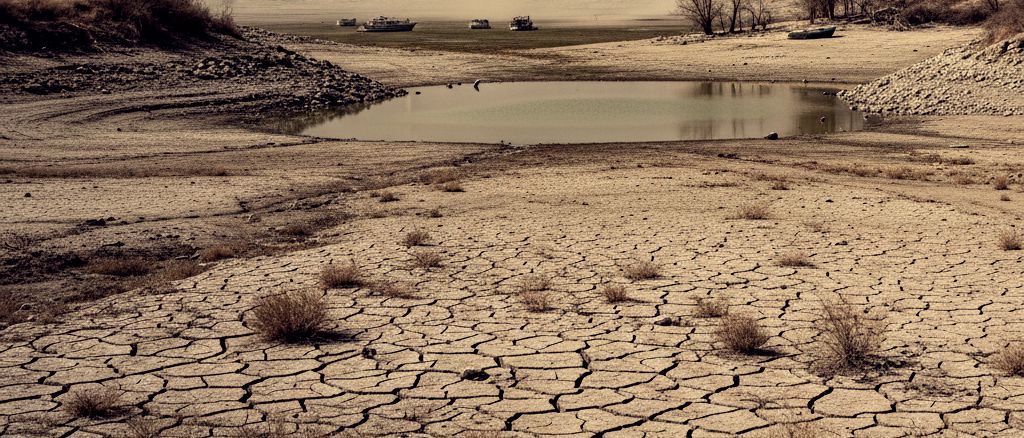
Iran is barreling into a full-blown water emergency, and this time, the tap could truly run dry — especially in its teeming capital. Tehran’s reservoirs are collapsing under a historic drought, prompting not just water-saving pleas but serious warnings from officials that the city may be forced to ration or even evacuate unless rain returns.
A Drought Decades in the Making
Officials say dam levels around Tehran are dropping to alarmingly low levels. The Amir Kabir (Karaj) Dam, a major drinking water source, currently holds just 8 percent of its capacity — down from roughly 86 million cubic meters last year. ℹ️ Across Iran, nearly 19 major dams are now operating at under 5 to 10 percent capacity. ℹ️
It’s not just a weather problem. Authorities and experts point to years of mismanagement, over-extraction of groundwater, and inefficient irrigation in agriculture — which accounts for more than 90 percent of the country’s water use. ℹ️ Meanwhile, rain has become a rare visitor: this water year, precipitation is down by more than 80 percent in some regions compared with the historical average. ℹ️
How Tehran Is Responding — And How It’s Touching Off Panic
To cope, water pressure in Tehran’s supply networks has been reduced at night. ℹ️ Authorities are calling on citizens to cut consumption by 20 percent. ℹ️ There have even been public holidays declared in Tehran — and in at least 10 other provinces — to curb both water and electricity demand. ℹ️
President Masoud Pezeshkian hasn’t minced words: if rain doesn’t come by late November, he said, “we’ll have to ration water. And if it still doesn’t rain, we’ll have to evacuate Tehran.” ℹ️ In an even more drastic statement, the president suggested that perhaps Tehran shouldn’t even remain the capital if its water supply can’t be secured long-term. ℹ️
Iranians are already bracing. In many neighborhoods, people are storing water in buckets and jugs. ℹ️ Some residents report water outages lasting 12 to 18 hours in a day. ℹ️ A young mother in Tehran told reporters, “We have to fill buckets to store every drop.” ℹ️
Cracks in the Ground, Cracks in Trust
Beyond the immediate bad news, the crisis is cracking Tehran — literally. Over-pumping of groundwater is causing land subsidence, especially around the capital. ℹ️ Experts warn that continued over-extraction could permanently damage underground aquifers. ℹ️
Political tensions are rising too. Critics say the regime has ignored long-known warnings from water experts, while satellite imagery and data on reservoirs suggest officials may have failed to act in time. ℹ️ Some public discussions and social media commentary blame years of corruption and misplaced priorities — pointing to expensive but inefficient water projects, as well as a neglect of basic conservation infrastructure.
The Islamic Revolutionary Guard Corps (IRGC), already deeply involved in many of Iran’s large infrastructure projects, is reportedly being pressed into a larger role in water management. ℹ️ But for many ordinary Iranians, that’s little consolation — when your faucet is sputtering, it doesn’t much matter who’s in charge.
A National Crisis With No Simple Fix
Analysts argue that short-term fixes — like water transfers or desalination — are being considered, but they may not be enough. ℹ️ Some suggest more radical restructuring: shifting from “supply-oriented engineering” toward a system built around aquifer restoration and equitable distribution. ℹ️
Land subsidence, water theft, and evaporation losses underscore that this is more than just a seasonal drought — it’s a systemic failure. ℹ️ Even if the skies open up soon, many say, Iran still faces a long recovery to restore its water security.
The Stakes: More Than Just Tap Water
If Tehran’s crisis continues, the political and human consequences could be severe. Experts warn of economic disruption, forced migration, and widening unrest — not just in urban centers, but across rural areas already squeezed by water scarcity. ℹ️
The question now: Can Iran manage its way out of this — or is this drought exposing a much deeper, structural drought in governance and environmental foresight? Either way, with a capital of more than 10 million on the brink, the crisis no longer feels distant. It feels dangerously close.